


Audit logs
Every workflow step stays traceable: inputs, outputs, reviewer and decision — so automation stays defensible.
AI-assisted recruiting only works when review gates, logs and forbidden uses are explicit before go-live. Hyron governs how far automation runs, what requires human approval, and what stays auditable — humans, agents and data in one controlled system. Not autonomous hiring: governed workflows you can defend to compliance and leadership.

05
Agents and workflow control
Typical focus
AI agents and AI-assisted recruiting workflows
What you receive
Workflow inventory, data flow register, review gates, log schema, quality rules, forbidden uses, pilot evidence and operating SOP
Governance scope
Review gates, audit logs, budget limits and explicit automation boundaries
Typical timeline
2–4 weeks per workflow or agent
Hyron governs how AI-assisted recruiting runs in your organisation — how far automation can go, what must be reviewed, and what requires explicit approval.
Hyron fits when you want AI in recruiting — and need a clear answer to how far automation can go while staying in control.
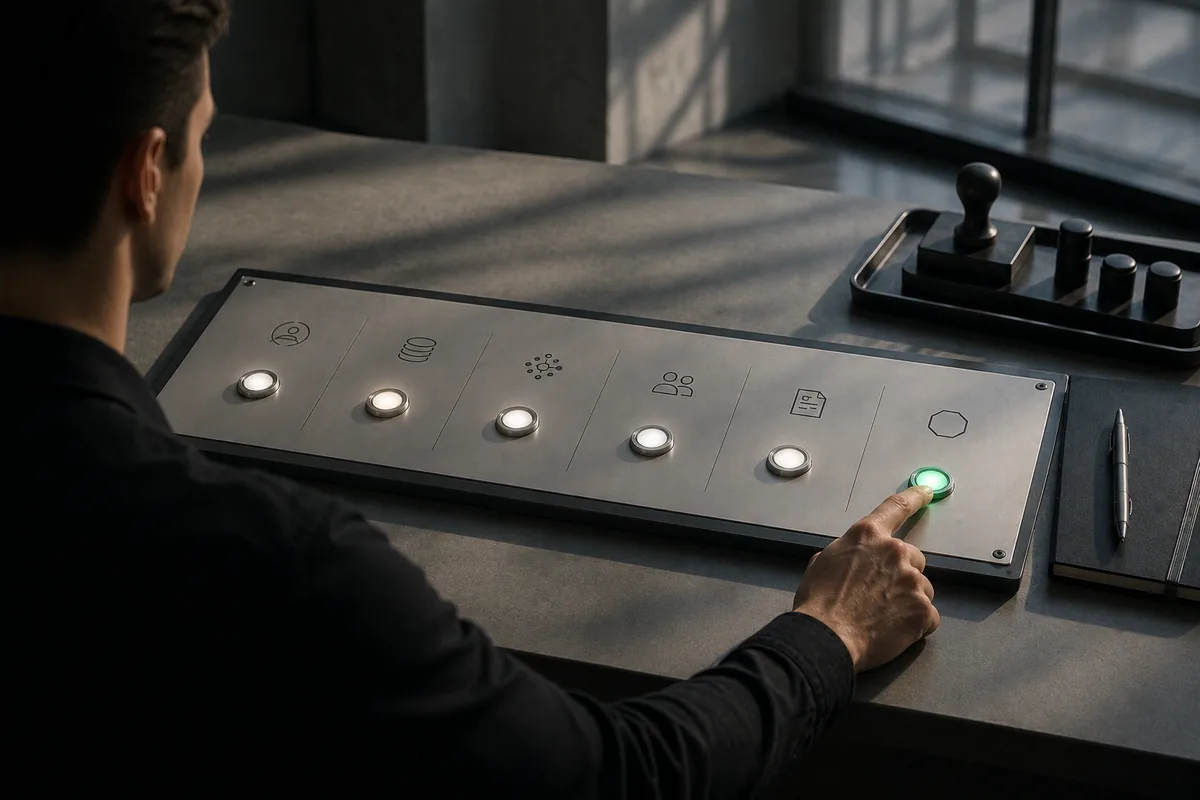
Operating depth is a separate choice — AdvisoryProjectEmbedded.
You sign off on pilot evidence and the operating SOP — with review gates, logs and boundaries your team can defend.
Every workflow step stays traceable: inputs, outputs, reviewer and decision — so automation stays defensible.
AI-assisted outputs reach your team only after explicit human review where the workflow requires it.
Workflows steered by data class, model, cost limit and risk profile — tailored to each step.
Decision-grade rationale for each step — explainable to your team and defensible in review.
We push AI-assisted steps as far as your governance allows — when owners, data approval and gates are in place. Maximum throughput within explicit control.
Going to the limit requires workflow owner, approved sources, gate design, log schema, quality rules and pilot evidence. We scale automation to match that readiness.

Bring the workflow, owner and data sources — we will tell you honestly what automation your governance can carry, and what must wait.
A short conversation about limits, readiness and what your governance can carry.

Done when: You sign off on pilot evidence and the operating SOP — with review gates, logs and boundaries your team can defend.

Named workflows with owners and scope.

Which data sources are allowed, and what goes in and out.
Human review before AI-assisted output reaches your team.
What gets logged for audit and learning.
How output quality is checked before and after review.

Documented boundaries — agreed before go-live.
Signed pilot artifacts — proof the control layer works under real use.

Day-to-day procedure for running the controlled workflow.
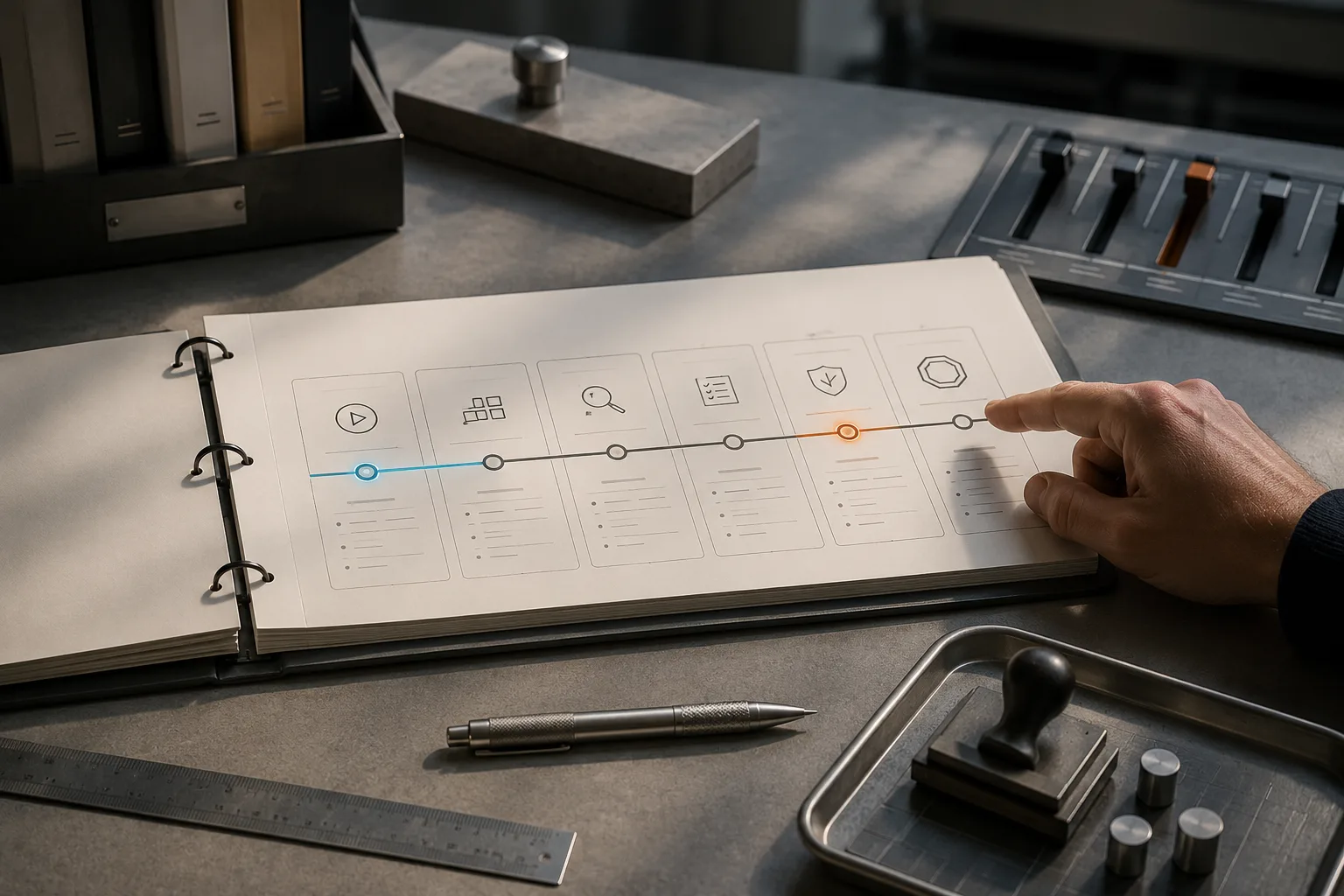
Recruitment as a System in practice — what the control plane covers, and what each signed artifact contains below.
Signal, Hire, Momentum and Command are recruitment as a service: they answer what is broken in hiring — market clarity, role execution, sprint rhythm or operating rules. Each delivers accountable outputs you can sign off on.
Complete when: You can explain how AI-assisted recruiting runs in your organisation — owners, gates, logs and boundaries your team can defend.
Design starts once a workflow owner is named and scope is bounded.
Complete when: Every in-scope workflow has an owner before design starts.
Only agreed data sources are used — new sources require explicit approval.
Complete when: Zero unapproved data sources in the operating design.
Every AI-assisted output has a defined review step before it reaches your team.
Complete when: 100% of AI-assisted outputs have a review gate.
Inputs, outputs, reviewer and decision — traceable without guesswork.
Complete when: 100% of log fields are defined before pilot.
Objective criteria your reviewers apply consistently.
Complete when: Pilot examples pass the agreed quality gate.
Explicit rules for what requires approval before AI runs in a recruiting workflow.
Complete when: Forbidden uses are documented and policy-approved.
A bounded test run with real or realistic cases at agreed volume. This pack bundles the artifacts from that run for evidence-based handover.
Complete when: All pilot artifacts are complete; quality gate passed or defects explicitly accepted — required before operating handover.
Documented day-to-day procedure operators can follow after handover.
Complete when: Sponsor and workflow owner sign the operating SOP.

Products define what we solve. Delivery defines how deeply Talentpark works inside your system.
How Hyron can show up at each depth:
AI workflow assessment
About advisoryControl layer pilot
About projectEmbedded control support
About embeddedTypical rhythm when delivered as a bounded project — advisory is shorter, embedded runs inside your live cadence.
We clarify workflow, owner, data sources and risk appetite — including how far you want automation to go.
If process baseline or ownership is missing, we point you to Command first.
We lock source list, outputs, review gates, logs and forbidden uses.
Build starts once sponsor and workflow owner sign the scope.
Map, gates, log schema and draft SOP with operators — including clear rules for reviewed and restricted automation steps.
Design is accepted when control logic is explicit and signed.
The workflow runs end-to-end within agreed boundaries: approved sources, active review gates, complete logs and quality checks on real or realistic cases.
This phase is mandatory before handover — exceptions, reviewer load and material corrections surface in use.
The pilot produces signed artifacts: run logs, gate decisions, exception log, quality results, budget summary and a Pilot Acceptance Summary — bundled in the Pilot Evidence Pack.
Operating handover follows an explicit accept, fix or stop decision.
SOP, risks and next workflow if needed. Runtime ownership and policy approval stay on your side.
Expanded automation later goes through a written change request.
Clear expectations from day one — including what we do not take on in this mode.

What Hyron controls, how far automation can go, where it runs, and why pilot and prerequisites matter.
No. Hyron defines governed AI-assisted workflows with review gates, logs, forbidden uses and agreed budget limits. Autonomous hiring is not sold — and we do not recommend it while human review, clear accountability and controllable spend remain essential. As models and governance mature, we can advise whether your operating context — including budget and control — is ready for expanded automation.
As far as your governance can support — when owners, approved data, gates, logging and quality rules are in place. We aim for the edge of what is controllable. Each step beyond human review requires explicit scope and acceptance.
Missing workflow owner, unknown or unapproved data sources, or rejected log requirements. Diagnostic may proceed to inventory gaps only — build starts when prerequisites are named and signed.
When process baseline is broken, market thesis is unclear, or you need one role executed without workflow design. Command, Signal or Hire may fit better as the first step.
Momentum when controlled workflows support recurring cadence, embedded control support at live depth, or the next workflow in a multi-workflow programme — each with its own scope and gates.
Scoped in design to your data policy — inside your existing infrastructure, connected to your own systems with approved cloud services, hybrid across on-premise and cloud, or Talentpark-managed infrastructure with bounded cloud access. Data sources, egress rules and retention are agreed before pilot.
A pilot is a bounded test run of the designed workflow: real or realistic inputs, full logging, review gates active and agreed scope — at smaller volume than full production, with signed artifacts. It proves gates, logs, quality rules and budget limits under your data policy, surfaces exceptions and reviewer load early, and gives your team evidence to sign against. You receive a Pilot Evidence Pack: Pilot Run Log, Review Gate Decision Record, Exception & Defect Log, Quality Gate Results, Pilot Budget Summary and Pilot Acceptance Summary. Operating handover requires those artifacts accepted.
Each product targets a different hiring failure layer — compare fit before you choose scope or operating depth.